English Bill Of Rights of 1688 Full Text

March 23rd, 2006

“Bill of Rights 1688”

An Act Declareing the Rights and Liberties of the Subject and Setleing the Succession of the Crowne

Whereas the Lords Spirituall and Temporall and Commons assembled at Westminster lawfully fully and freely representing all the Estates of the People of this Realme did upon the thirteenth day of February in the yeare of our Lord one thousand six hundred eighty eight present unto their Majesties then called and known by the Names and Stile of William and Mary Prince and Princesse of Orange being present in their proper Persons a certaine Declaration in Writeing made by the said Lords and Commons in the Words following viz

Whereas the late King James the Second by the Assistance of diverse evill Counsellors Judges and Ministers imployed by him did endeavour to subvert and extirpate the Protestant Religion and the Lawes and Liberties of this Kingdome

1. By Assumeing and Exerciseing a Power of Dispensing with and Suspending of Lawes and the Execution of Lawes without consent of Parlyament.

Bringing EU law into UK law.

2. By Committing and Prosecuting diverse Worthy Prelates for humbly Petitioning to be excused from Concurring to the said Assumed Power.

3. By issueing and causeing to be executed a Commission under the Great Seale for Erecting a Court called The Court of Commissioners for Ecclesiasticall Causes.

4. By Levying Money for and to the Use of the Crown by pretence of Prerogative for other time and in other manner than the same was granted by Parlyament.

Spending money for War without permission of the population.

5. By raising and keeping a Standing Army within this Kingdome in time of Peace without Consent of Parlyament and Quartering Soldiers contrary to Law.

Military industrial complex.

6. By causing several good Subjects being Protestants to be disarmed at the same time when Papists were both Armed and Imployed contrary to Law.

Banning guns after a single incedent.

7. By Violating the Freedome of Election of Members to serve in Parlyament.

Postal Ballots.

8. By Prosecutions in the Court of Kings Bench for Matters and Causes cognizable onely in Parlyament and by diverse other Arbitrary and Illegal Courses.

Secret court sessions; terrorism act.

9. And whereas of late years Partial Corrupt and Unqualifyed Persons have been returned and served on Juryes in Tryalls and particularly diverse Jurors in Tryalls for High Treason which were not Freeholders.

Ending trial by jury. Introducing double jeopardy.

10. And excessive Baile hath beene required of Persons committed in Criminall Cases to elude the Benefitt of the Lawes made for the Liberty of the Subjects.

Tagging of prisoners.

11. And excessive Fines have been imposed.

Taxes taxes and more taxes, and fines.

12. And illegall and cruell Punishments inflicted.

Rendition. Guantanamo.

13. And severall Grants and Promises made of Fines and Forfeitures before any Conviction or Judgement against the Personsupon whome the same were to be levied.

‘Criminals’ can now have their assets siezed without reason. Transfers of cash must now be reported to government if they are ‘too big’.

All which are utterly and directly contrary to the known Lawes and Statutes and Freedome of this Realme. […]

http://zenblues.blogspot.com/

We have been here before it seems.

Parliament must be completely reformed and made into a tool whose sole purpose is to serve the population. That means they must be made into street sweepers and ditch clearers. International shenanigans, intrigue, nation building, border drawing –  none of this has anything to do with clean streets and our rights.


The Final Powergrab: the power to make law at will

March 23rd, 2006

What’s The Problem?

The boringly-named Legislative and Regulatory Reform Bill is in fact a very dangerous piece of legislation. It grants any minister the ability to amend, replace, or repeal existing legislation. The frightening thing is this: they would be able to make major changes to the law without Parliament being able to examine it properly, taking away the ability of Parliament to meaningfully represent the citizens of this country.

Limitations

The only limitations are that the changes may not:

  • impose new taxes,
  • create new criminal offenses with a sentence of more than 2 years, or
  • authorise forced entry, search or seizure, or compel the giving of evidence.

This means that if a minister got up in a bad mood, he could decide to make laughing in public punishable by 2 years in prison by amending the Serious Organised Crime Act. Or if he was late to work, he could arbitrarily do away with speed limits by amending the Road Traffic Act.

More worryingly, the minister involved can amend any existing legislation; nothing is protected. So, as was pointed out in The Times by 6 law professors from Cambridge, a minister could abolish trial by jury, suspend habeas corpus (your right not to be arbitrarily arrested), or change any of the legislation governing the legal system.

That’s 700 years of democracy and the rule of law, thrown away in a heartbeat. What’s left of the Magna Carta, the foundation of just about all modern democracies, would be finally gone, and our Parliament, which has influenced democratic systems all over the world, would just be a footnote in history.

What Is It For?

Ministers claim that the bill is needed to allow them to cut down on red tape, to help eliminate unnecessary regulation and bureaucracy without having to go through Parliament, thus speeding up the whole process and making it more efficient.

However, there is nothing in the bill that restricts it only to that use. It can be used to change any legislation, without exception. Moreover, the government has actually rejected amendments that would have limited the power of the Bill.

Rigorous Safeguards

The government has referred to the protection provided by the “rigorous safeguards” that are built into the bill. However, these are in fact far from rigorous. The only safeguard is that the minister who is making the order should be convinced that:

  1. the policy objective intended to be secured by the provision could not be satisfactorily secured by non-legislative means;
  2. the effect of the provision is proportionate to the policy objective;
  3. the provision, taken as a whole, strikes a fair balance between the public interest and the interests of any person adversely affected by it;
  4. the provision does not remove any necessary protection;
  5. the provision does not prevent any person from continuing to exercise any right or freedom which that person might reasonably expect to continue to exercise.

These are vague at best, and seeing as only the minister involved has to be satisfied with the answers, these safeguards give no protection at all. Even senior government figures have called the safeguards “inadequate”.

Delegation

The Bill also allows ministers to give the power to pass laws to other individuals, who are not necessarily ministers. This delegation means that unelected officials, or even people outside government, could easily end up with the power to make laws that bind us all.

For instance, an order could be passed that allowed police superintendents to retrospectively create new offences, which could be punishable by up to 2 years’ imprisonment. This would make policing “more efficient” as it would avoid losing cases on legal technicalities. The Bill is unclear on whether these delegated orders would have to go before Parliament at all!

We Have Their Word

When presenting the bill, Jim Murphy MP, who seems to have the job of getting this bill passed, said:

I give the House clear undertakings, which I shall repeat in Committee, that the orders will not be used to implement highly controversial reforms.

This is not enough. The current government can promise not to abuse its power all it likes, but can it speak for every government that will exist after it? If the bill should not be used for “controversial reforms”, then that limitation should be written into the bill. As it stands, the bill can modify any existing legislation, without exception.

Do you trust the current government with that kind of power? Even if you do, do you automatically trust every future government with that same power?

Self Modifying

One of the most dangerous aspects of the Bill is that it also applies to itself. This means that even the few safeguards and limitations that are built into the bill could be removed without Parliamentary scrutiny.

Rushed Through

On top of all its problems, the bill is being rushed through Parliament very quickly. This bill has massive significance for the constitution of the UK, and yet Parliament will have only one hour in which to debate it during its third reading.

The bill recently completed its progress through the Committee Stage of the House of Commons without any major changes, so this bill is in serious danger of going all the way without being stopped!

Next: What Can I Do?

http://www.saveparliament.org.uk/problem.html

As I have said before; we are long past the time where we should not have to keep looking over our shoulder because new law is coming over the horizon. In order for this populatoin to be free, legislation needs to be constantly removed from the statues, not added. Parilament should be instructed only to remove legislation, and not to introduce new legislation.


US wants to hold up Canadian traffic

March 23rd, 2006

Canadian diplomat says new U.S. border security measures are onerous 

MONTPELIER, Vt. (AP) – Canada’s top representative in New England came to Vermont on Wednesday to plead for help in opposing tough new border security measures planned by Washington on the U.S.-Canadian border.

Stan Keyes, the consul general at the Canadian Consulate in Boston, made his pitch at a luncheon with members of the general affairs committees of the state House of Representatives and Senate, where he had a sympathetic audience.

Keyes sought to emphasize Vermont and the United States’ long-standing trade relationship with Canada, and argued that both international trade and tourism could be severely hurt if the U.S. administration pushes ahead with its plan.

Rules crafted by the State and Homeland Security departments, designed to implement legislation passed by Congress in 2004, will require passports for air and sea travel between Canada and the U.S. and between other Western Hemisphere countries and the U.S. They take effect at the end of this year.

Effective Dec. 31, 2007, crossing land borders into the U.S. also will require a passport or a specially designed “PASS card,” which would not be usable at air or seaports. New rules designed to bring more scrutiny to truck traffic and other commerce also are being developed, said Jarrod Agen, spokesman for the Department of Homeland Security in Washington.

The new rules will “seriously impede some $1.1 billion in trade and hundreds of thousands of travellers who cross the U.S.-Canadian border every day,” Keyes said.

Keyes said Canada’s desire for a go-slow approach to the new rules had won support from governors around New England and in other border states, and that several state legislatures were working on or had passed resolutions containing the same message.

He said he hoped Vermont legislators would pass a currently pending joint resolution that would put them on record as opposing the new rules.

In an earlier comment to a post I talked about something like this, and sure enough here you go. What this ambassador fails to understand is that the US wants to do this to the entire world. The fact it does a lot of trade with us is irrelevant, the fact that many businesses and families rely on the (perfectly reasonable) easy border-cross is meaningless. I think it’s quite clear the US simply wishes to make it very difficult for any travel over its borders, in either direction, because it wants to establish some kind of psychotic police state (we’ve talked about that ad nauseum…). In this case, it really doesn’t matter if everyone involved “opposes the new rules.” Everyone benefits from how things are right now. I know I benefit from it in some way, and would even more if for some (ludicrous) reason I wanted to cross the border. That doesn’t matter. Homeland Security is not about making advantageous decisions… can’t people see what its real agenda actually is? Sheesh.


gpg flaw

March 22nd, 2006

GnuPG does not detect injection of unsigned data
================================================
(released 2006-03-09, CVE-2006-0049)

Summary
=======

In the aftermath of the false positive signature verfication bug
(announced 2006-02-15) more thorough testing of the fix has been done
and another vulnerability has been detected.

[…]

Impact:
=======

Signature verification of non-detached signatures may give a positive
result but when extracting the signed data, this data may be prepended
or appended with extra data not covered by the signature. Thus it is
possible for an attacker to take any signed message and inject extra
arbitrary data.

Detached signatures (a separate signature file) are not affected.

All versions of gnupg prior to 1.4.2.2 are affected.

[…]

GPG [announce]

Those of you using earlier versions of GPG will no doubt want to upgrade.


They must be on drugs!

March 21st, 2006

Dutch coffee shops introduce fingerprint ID

Jan Libbenga / The Register | March 21 2006

Some Dutch coffee shops, which sell marijuana in small quantities for personal use, are introducing fingerprinting technology to check the age of customers.

The shops are not allowed to sell to anyone under the age of 18. Coffee shops currently require photographic ID for proof of age.

The first coffee shops to use turnstiles with built-in fingerprint sensors are Inpetto in Rotterdam, Birdy in Haarlem, and ‘t Rotterdammertje in Doetinchem in the east of the country. Customers must first register with the shops, but personal details will not be stored.

The technology has been developed by FingerIdent, a company owned by Gerrie Mansur, one of the members of legendary Dutch hacking group Hit2000. According to Mansur, the system can match 35,000 fingerprints in less than a second. […]

http://infowars.com/articles/bb/biometric_id_dutch_coffee_shops_fingerprint_id.htm

Heh…’I couldn’t resist’: the new catchphrase!


The lady doth protest too much, methinks

March 21st, 2006

The more the pigs squeal about how good things are, the more shit you know must be piling up.

The bigger the pig, the louder the squeal, the smellier the shit.

Blair is fundamentally wrong.

Bush is clueless.
Steve Bell is right on the money.
http://image.guardian.co.uk/sys-images/Guardian/Pix/steve_bell/2006/03/20/steve.jpg


present and incorrect

March 21st, 2006

A NATIONAL identity card scheme will be a “present” to terrorists, criminal gangs and foreign spies, one of Britain’s most respected former intelligence agents has told ministers.

[…]

Baroness Park, who was made a peer by Margaret Thatcher, passed a withering verdict on the proposed cards, ridiculing ministers’ suggestions that the system will make people safer. In fact, she said, the complete opposite is true.

“The very creation of such an enormous national identity register will be a present to terrorists; it will be a splendid thing for them to disrupt and blow up [!!!-mm],” she said.

“It will also provide valuable information to organised crime and to the intelligence services of unfriendly countries. It will be accessible to all of these,” she said.

[via bribery and database cracking, but of course peoples lives will be disrupted by ‘functionally fit’ false ID without the need for accurate NIR information – because some companies or institutions will accept the cards at face value]

The warning about the risk of foreign spying comes at a time when MI5, the domestic security service, has cut its counter-espionage budget, prompting concerns among MPs who oversee the UK intelligence services.

Baroness Park concluded: “I find it extraordinarily difficult to believe why anyone would voluntarily and enthusiastically come forward and say: ‘Do let me join this dangerous club’.”

Baroness Park is not the first former intelligence officer to question the value of a national ID card. Dame Stella Rimington, the former head of MI5, last year said she did not believe the cards would make Britain any safer from terrorist attack; they would quickly be copied, she said.

Whereas Dame Stella’s background was in combating internal threats, especially the IRA, Baroness Park has extensive experience of foreign intelligence operations.

[…]

From The Scotsman

In other news another government IT project has failed it – but this time due to ‘user non-compliance’, ;

At the meeting, the head of the watchdog, Sir John Bourn, said his report will say the government project had failed to win the “hearts and minds” of the NHS staff required to use it.
The project’s failure to “take the people in the National Health Service with them” meant it had become a “focus of dissension” amongst GPs and consultants.

And of course I mean;

At the meeting, the head of the watchdog, said her report will say the NIR project had failed to win the “hearts and minds” of the public required to register.
The project’s failure to “take in the people of the country” meant it had become a “focus of dissension” amongst Citizens and Residents.


Beard Moustache White Trainers

March 21st, 2006

http://30gms.com/index.php?/permalink/beard_moustache_white_trainers/

This is disgusting. I too have a beard, moustache and wear white trainers. My hair was quite a bit longer up until a month or so ago. But I’ve haven’t been stopped recently. Is it because I have white skin and blue eyes?

The irony is that this guy is working on a site for the Home Office that deals directly with this. I wonder how he can go on working on it with a clear conscience after this has happened to him.


Supreme Court Justice warns against animal tagging

March 20th, 2006

Are you familiar with NAIS? Let me give you a little background. The USDA wants to register the GPS coordinates, name, address, phone, and other data on every farm, home, and other location that has even has a single animal, with a government Premise ID. For this privilege of mandatory registration, you will pay a fee of $10 or more, per year. Next, they intend to tag every single one of your animals with a RFID, or other tag. This will be mandatory. In addition to paying an annual fee and paying for tags for all of your animals, you would also be required to log, track, and report all “events,” such as the birth of an animal, death of an animal, animals leaving, or entering your property. All reports must be made within 24 hours, or you could face stiff fines. Do not expect them to keep your private information secure. In a little “Oops,” the USDA just released the social security numbers of 350,000 farmers.

Big producers, like factory farms, get to use a single batch ID for tens of thousands of animals,to keep their costs down. For them, NAIS is a minor bookkeeping entry that gives them big profits in the export markets to Japan and other countries. Small farmers and homesteaders, with their mixed-age flocks and herds, would be required to tag and track every single individual animal. NAIS is great for big corporate producers, and hellish for small farmers and homesteaders. The cost of NAIS in fees, tags, equipment costs, and time will bankrupt small farmers, and overwhelm people who raise their own food animals. In the end, the consumer will pay – NAIS could add almost a thousand dollars a year to the annual food budget for the typical family of four. By destroying small producers, NAIS will kill the Slow Food and the Buy Local movements, as local farmers are driven out of business.

NAIS is already mandatory in some states, starting this year, including Texas and Wisconsin. In other states, like Vermont, the agricultural commissioner and state vet have said they will tag and track every animal, right down to the back yard level. This means everyone, even Granny with her one laying hen, is going to have to get a $10 per year premise ID, a RFID tag for her chicken, and make government reports on its movements. Texas has implemented a $1,000 per incident per day, fine for non-compliance. What small farmer or homesteader can stand up to that kind of fire power? […]

USDA agents can come to your home, and kill all of your livestock, without a warrant or any legal appeal under NAIS. Once you are registered into the mandatory NAIS system, you effectively lose your rights to your own livestock. You become a serf for the state, worse than in Communist Russia. If you do not believe me, then please go to the USDA web site, and read the draft proposal for NAIS, which is already being implemented in stages, without public feedback or scrutiny. Check out the timeline – we all must start fighting it now, before it is too late. Together, we can stop this fascist move to take away our property and livelihoods. We can still protect our traditional rights to farm, if we act now. […]

Justice William O. Douglas,
U.S. Supreme Court (1939-75)
http://www.eco.freedom.org/el/20060301/walterjefferies.shtml

They have some real problems going on over there don’t they?

American’s wont’t accept a state issued national ID card, so the corporations who are set to fleece every sheepish supjecte have arranged to tag every animal in the USA.

Also, since only 23% of people have passports, they can’t pull the same ‘its not compulsory compulsion’ trick that they are trying here; 80% have passports in the UK, and so the ‘sheering point’ is more accessible.

Animal, Man, its all wool right?


We like the tone!

March 20th, 2006

Charles Clarke: Hog-wild UK regime liar

Charles Clarke liarCharles Clarke, the porcine liar and doublespeaking attack-swine, paid off to impliment the scorched-Earth, Orwellian society-rewriting policies of that other infamous fabricator Blair, again displays his true bacon-flavoured colours, this time in assaulting the father of 7/7 victim who dared to actually ask the tinpot regime for an official inquiry into the events of last July that injured his daughter.

Clarke’s distressed and desperate response of “You’re insulting me. Go away. I don’t need to be insulted by you” is of course highly reflective of his disposition and why he’s in the job to begin with.

Underneath those bristly flapping jowls that deliver so many appalling lies is a prissy sissy little ego loyal to his sociopathic regime master.

Of course he had to apologise for snorting this out, and indeed one has to speculate very sincerely, at quite why the regime is so sensitive, petrified and desperate to avoid a full public inquiry into the ‘worst act of terrorism on British soil’, but are more than happy to grandstand off it’s results and use their version as a rationale for delivering their Earth-shattering philosophy of tyranny and enslavement. […]

http://jultra.blogspot.com/

Oh yes!!!


The last thing a broken dam needs is another hole

March 20th, 2006

What with all the controversy about occult loans to the labour party leading to nominations for peerages it has been suggested by some quarters that there should be consideration of taxpayers fnding political parties (Bliar and Prescott it seems)

This is entirely the wrong solution and if polls are to be believed thankfully 73% of the country are ‘against’ such moves. Although given that 80% didn’t vote for labour politicians at the election Bliar will probably view this as an ‘overwhelming mandate for reform’.

Firstly the current scandal is not that political parties are receiving large, private donations; it is that these loans are being used by the political parties to cover up their funding and for the government to be perceived to be using loans as a tool of patronage – to repeaat in neither case is the act of receiving private funding a problem and it is not this aspect that requires attention.

Secondly political parties are not required for a (true) parliamentary democracy to exist, the fact that independent members and members of very marginal parties have been elected to parliament show that it is not necessary to have the support of a large party to be elected. Of course parties make easier to identify what sort of promises will be broken by each MP and in any case we are talking about funding and not the abolition of politival parties (now!).

Thirdly if by some tragedy tax funding of politics were to be extended many of the activities that political parties currently undertake such as (commissioning think tank) reports and policy studies could be organised ‘independently’ by Select Commitees rather than political parties, that way we could possibly get less partial findings and avoid replication of spending.


Will The Royal Family Get ID?

March 20th, 2006

[…]

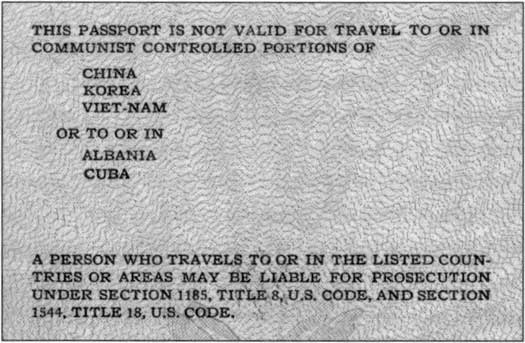
Prominent people with views that were considered to be associated with Communism, such as Paul Robeson, were once prevented from travelling abroad by the U.S. government. W.E.B. DuBois, founder of the NAACP, was accused of pro-Communist sympathies and denied a U.S. passport. He renounced U.S. citizenship afterwards. However, the U.S. Supreme Court held in the 1958 case Kent v. Dulles that international travel was an inherent right which could not be denied to American citizens. The US government has two primary methods to get around this ruling though. The first is to declare US passports illegal (or “invalid”) to use for travel into or through a particular country by US citizens without special permission. The second is to ban US citizens from spending any money related to travel into a particular country without special permission. Sometimes the two are combined to make it effectively impossible for everyday US citizens to exercise their rights established in Kent v. Dulles to travel abroad freely. The US government can get away with this because the two methods are not technically travel bans since it’s only a ban on using a passport or spending money. Even so, the US State Department still has the right to screen people before issuing a passport and to revoke a passport.

As mentioned before, at various times, US passports have been issued with a list of countries or regions to which the holder is forbidden to travel using the passport without special permission. These countries have previously included Albania, Cuba, People’s Republic of China, Iran, Iraq, Lebanon, Libya (removed in 2004), North Korea and Vietnam. In 1957 China protested their inclusion in this list and successfully campaigned for its removal. The US State Department oversees these restrictions, and will implement them usually in response to what they perceive to be clear and present dangers to Americans travelling in the aforementioned countries. Despite this, it is alleged that politics appears to be the actual motivation, as US citizens who have defied passport restrictions and gone to such countries sometimes report no danger whatsoever. When the US State Department bans passports from being used to travel to a certain country, it will usually state in the passport or on government websites that the US passport is “invalid” for travel to the particular country. To legally use a passport for travel to such a country, one must obtain a special endorsement or “validation” from the US State Department. Such exceptions to the passport travel bans are usually given to International Red Cross workers on a sponsored mission, those visiting family in such countries or those whose travel “is in the national interest.” Travellers that choose to ignore the restrictions try to do their best not to get their passport stamped or keep any receipts indicating travel to such a country. As of March 2006, US passports are valid for travel to all countries in the world. Although US citizens are no longer banned from using their passports to travel to Cuba, because of U.S. Treasury Department restrictions on U.S. citizens who visit Cuba, that country will similarly not stamp a passport, as it is now against Cuban law to stamp American passports. Thousands of Americans defy this de facto travel ban by going through third countries like Mexico, Jamaica, or the Dominican Republic. US pre-clerance customs agents sometimes catch and report US citizens getting off Cuban planes in Canada and the Bahamas. They then run the risk of being fined by the US government upon return to the United States. As of March 2006, Cuba is the only country that the US government officially restricts its citizens from visiting.

23% of Americans in 2005 have a passport. Unlike most other parts of the world where one needs a passport just to travel 3 hours in the same direction, Americans can travel passport-free within a landmass roughly twice the size of Europe and a passport is not required to travel to Canada or Mexico. Nor do American citizens require a passport to return to the United States from locations in the Western Hemisphere. However, according to a new law, a passport will become necessary in order to return to the U.S. from these locations by air or ship by the end of 2006 and for entry via land border crossings by the end of 2007. In the meantime, for American citizens returning from locations in the Western Hemisphere, a US birth certificate or sometimes even a US driver’s license often is enough.

[…]

The British Monarch

The British Monarch, who is also the monarch of Canada, Australia, New Zealand, et cetera, does not carry any passport, and this is not because of her status as the sovereign of more than one country. The real rationale is that, in a monarchy, passports are issued in the name of the monarch to her subjects, asking foreign governments to grant the passport holders free passage, assistance, and protection. Since the monarch cannot issue a passport to herself – and, in any case, she can personally ask foreign governments for her own free passage, assistance, and protection – she does not carry any passport. […]

http://en.wikipedia.org/wiki/Passport

Does this mean that Her Majesty will be exempt from getting an ID card? If she doesn’t hold a passport, that means that she will never be compelled to be entered into the NIR.

Hmmmm!!!


Some Ugly Stuff For You

March 20th, 2006

Here are just a few Executive Orders associated with FEMA that would suspend the Constitution and the Bill of Rights. These Executive Orders have been on record for nearly 30 years and could be enacted by the stroke of a Presidential pen:

* EXECUTIVE ORDER 10990 allows the government to take over all modes of transportation and control of highways and seaports.

* EXECUTIVE ORDER 10995 allows the government to seize and control the communication media.

* EXECUTIVE ORDER 10997 allows the government to take over all electrical power, gas, petroleum, fuels and minerals.

* EXECUTIVE ORDER 10998 allows the government to take over all food resources and farms.

* EXECUTIVE ORDER 11000 allows the government to mobilize civilians into work brigades under government supervision.

* EXECUTIVE ORDER 11001 allows the government to take over all health, education and welfare functions.

* EXECUTIVE ORDER 11002 designates the Postmaster General to operate a national registration of all persons.

* EXECUTIVE ORDER 11003 allows the government to take over all airports and aircraft, including commercial aircraft.

* EXECUTIVE ORDER 11004 allows the Housing and Finance Authority to relocate communities, build new housing with public funds, designate areas to be abandoned, and establish new locations for populations.

* EXECUTIVE ORDER 11005 allows the government to take over railroads, inland waterways and public storage facilities.

* EXECUTIVE ORDER 11051 specifies the responsibility of the Office of Emergency Planning and gives authorization to put all Executive Orders into effect in times of increased international tensions and economic or financial crisis.

* EXECUTIVE ORDER 11310 grants authority to the Department of Justice to enforce the plans set out in Executive Orders, to institute industrial support, to establish judicial and legislative liaison, to control all aliens, to operate penal and correctional institutions, and to advise and assist the President.

* EXECUTIVE ORDER 11049 assigns emergency preparedness function to federal departments and agencies, consolidating 21 operative Executive Orders issued over a fifteen year period.

* EXECUTIVE ORDER 11921 allows the Federal Emergency Preparedness Agency to develop plans to establish control over the mechanisms of production and distribution, of energy sources, wages, salaries, credit and the flow of money in U.S. financial institution in any undefined national emergency. It also provides that when a state of emergency is declared by the President, Congress cannot review the action for six months.

[…]

http://educate-yourself.org/nwo/FEMAsecretgovt1995.shtml


Some Beauty For You

March 19th, 2006

http://www.flickr.com/photos/——-/ 


Trapped in an Oyster Net

March 19th, 2006

BBC Online

Monday, 13 March 2006, 20:57 GMT

Oyster data is ‘new police tool’

Police are increasingly turning to Oyster travel cards to track criminals’ movements, according to new figures.

The smartcards, used by five million Londoners, record details of each bus, Tube or train journey made by the holder over the previous eight weeks.

In January, police requested journey information 61 times, compared with just seven times in the whole of 2004.

The Metropolitan Police said it was a “straightforward investigative tool” used on a case-by-case basis… […]
http://news.bbc.co.uk/1/hi/england/london/4800490.stm

This sounds entirely reasonable, except when you take a close look at the facts.

Oyster doesn’t need to record eight weeks of your journeys in order to do the job it has to do; charge you for using public transport.

Unless of course it has been designed to track you.

All they need to store is how much money you have left on your card, so that when it is swiped, you can be debited and let on the bus or underground. A clean, non orwellian system could do this, and would actually cost them less to run since they would not be storing up all those journey details and making infrastructure available to others to provide access to the data.

And as for ‘case by case basis’ in the MSQL era, case by case means looking at every journey with a search query, or looking at swipes in real time, as they are done, one by one, case by case.

Amazingly, they have not yet put cameras on every Oyster swipe point. Imagine that every time you tap to get on a bus, a camera stuck on top of the reader inside the drivers cabin, takes a photo of you. This would render anonymous Oysters useless, since your face would be linked to the number of your card.

Maybe a feature for ‘Oyster 2.0’.

Oyster is no “straightforward investigative tool”. Surveillance on this scale has never been possible before, and in the past, if you wanted to do it, you needed explicit permission and a real reason to follow someone as they went about their daily business…it used to be called ‘putting a tail on someone’.

Looking into the future, Oyster is going to allow you to buy newspapers and stuff whereever there is n Oyster terminal. They have five million users; a huge userbase to turn loose on the shops of London. They will of course, record all of those transactions as well. The problem is not that they can and will do this; the real problem comes when this is the only way that you can buy and sell anything anywhere.

A state issued currency card, that can be filled up from your bank account, or from other cards via a simple two slot terminal similar to those Chip and Pin machines that are now everywhere, will spell the end of financial privacy. The system operators (the Bank of England) will keep a record of every transaction you make. Barter and any type of trade that excludes money will be made illegal, since they will be ‘off system’. Don’t think this can happen? The outlawing of all other forms of currency in favour of the state currency has already been done at least once; in Las Vegas, people used to use casino chips to buy anything. These chips were all redeemable for cash at the issuing casino so they were as good as money for all purposes. When this chip economy got huge, it was outlawed because private transactions began to dissapear into the invisible chip economy. The response will be the same if a state issued currency card comes into being.


Alberta gets something right for a change

March 18th, 2006

Michael Geist reports that the Alberta government has proposed legislation that blocks the US Patriot act:

The Alberta government last week introduced Bill 20, which is designed to stop compelled disclosures of personal information under the USA Patriot Act. The bill creates fines of up to $500,000 for violating provincial laws governing disclosure of records. The fines arise for violation of the following provision:

“A person must not wilfully disclose personal information to which this Act applies pursuant to a subpoena, warrant or order issued or made by a court, person or body having no jurisdiction in Alberta to compel the production of information or pursuant to a rule of court that is not binding in Alberta.”

With B.C. and Alberta leading the way on this issue, the pressure for action at the federal level should continue to grow.

The link to the Bill will provide more detail. This current Alberta government is interesting as it has always had a perplexing stance on privacy laws. While it writes bills to improve privacy and protection of information for every citizen of the province, Premier Klein has also made a new bureaucratic (new as in the last decade) office solely directed towards the purpose of limiting the public’s access to the goings-on of the provincial government (of course it’s not advertised as such but just TRY to get some information Klein doesn’t want you to get). Quite an interesting paradox because that information is NOT private is belongs to every citizen of the province, including myself.

Also interesting about this rather progressive legislation is that on the other hand, the AB Government’s health care legislation is completely REgressive, aiming to replace our public medicare with US-style profit-based health insurance (the talking heads deny this, but we KNOW it to be true).

Off-Topic, last night I saw the movie for “V for Vendetta,” which while being a watered down version of the great graphic novels, is still a good movie by it’s own right (even though Alan Moore’s name doesn’t appear in the credits, and despite a single innapropriate Wachowski-Brothers fight scene). It provides some great extrapolating of the current ID-and-Surveillance madness in Britain, especially a scene in which V uses Evey’s ID-card to commit a crime, thereby implicating her instead. The policemen on the case know that it’s unlikely she did it, but the government goes along with it because it’s not only easier, but they CAN. Don’t TELL me this wouldn’t happen in real life! Another great scenes involves a routine patrol van canvassing a neighborhood at night, listening to every phoneline and coversation they pass, monitoring and logging any cases of sedition or independant thought. That being said, the fascist National Front-esque government portrayed is still a bit soft compared to what WE know they are capable of.

PS: There maybe should be a category for Film?


records

March 18th, 2006
effaced records